Dairy Farming in Australia with robots and perseverance

In 2007, Symone and Phil Vines moved from Northern Victoria to the South West region of the state, because it had reliable rainfall. In 2009 they leased their first farm in the dairy farming district known as the ‘Heytesbury’ which came with the option of buying the herd. There was no family farm or cows and so they literally had to start from scratch. Rather fittingly, they named their first cow Hope and when a nearby farm came up for sale four years later, they took a leap of faith and bought the 117 hectares, while continuing to run the leased dairy property.
By 2016, the now family of six, really needed to upgrade the aging herringbone parlour. Their forward-thinking bank manager suggested they consider robots. “We set off to look at them and rule them out” explains Symone “but when we saw how quiet the cows were on robotic farms, Phil decided that this was the route we would go down.”
Greenfield Site
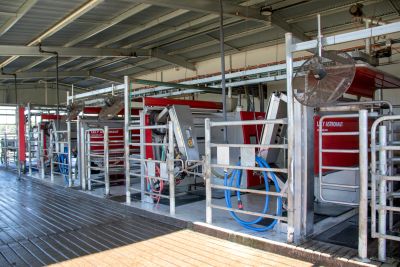
The family went ahead and built a greenfield site for 240 cows with four Lely A4’s but three weeks before they were due to start up, the milk price crashed. “I remember sitting on that greenfield site with a glass of wine, crying and thinking that we are not going to get through this, but we did,” Symone said.
Today the herd is predominantly Holsteins with some Jerseys and Normandes. Running on a hybrid system, the cows mostly graze by day and are housed at night. “The winters can get very wet down here,” explains Symone “so in 2018 we built a compost barn so that we could house the cows when needed. We use the compost barn in winter to protect our pasture, and in the summer, it is used on hot days for cow comfort.”
Herd Performance

Today the herd of 260 are split, with fresh calvers grazing close to the robots by day where they average 2.8 milkings a day. The late lactation cows walk up to 500 metres, using an AB two-way system, where they average 2.4 milkings per day. All cows are fed zero grazed grass and a TMR mix when they come together in the compost barn. “This is a perfect combination for us,” explains Symone” because we feel that we are getting the most efficient use from the grass.” The herd produces some 640Kg of milk solids per cow per year, which equates to around 8000 litres.
The whole system has been developed to work with the climate in their region where they can get very wet winters and dry summers. As a result, they also grow multispecies crops for grazing as they have minimal irrigation available. “We use different species in the mix that are drought resistant explains Symone and in the past we have also grown grazing maize.”
PLANS FOR THE FUTURE
A decade on from installing the robots the couple are entering a new phase as most of the capital work is completed and the main focus is now on reducing their debt. “Our goal is to become more efficient, to work smarter and not harder” says Symone.
“We are not interested in increasing cow numbers, but we do want to increase our milk solids per cow to over 700Kg.”
The robots have been well maintained by Symone and Phil and they plan to keep them going for another ten years. “People often ask us when we are planning on upgrading them but why would we when they are not broken”?
“Starting with one cow and no safety net we have built something that we are incredibly proud of” says Symone. It has also given their son Bailey the opportunity to farm with them. “When people say it’s impossible to get into this industry…… I think, it’s been a hell of a ride but we did it!”
Maximising production per robot
Ostergard Farm.Sweden
Daniel Gatas farms just outside Gothenburg with his cousin Jonas and their families in the southern part of Sweden. They are the 4thgeneration to farm at Ostergard and with Daniel’s son, Ruben following in their footsteps, the farm is now secure for the next generation.
Daniel began milking with robots just over 20 years ago, starting out with one Lely A2 in 2005 with 65 cows in milk, on a housed free access system. In 2010 he extended his cubicle housing and feed passage, pushing his numbers up to 130 cows with an additional robot. Both machines were then part exchanged for A5’s when they were launched in 2019.

Output
The herd year is year-round calving and run as one group, so the challenge is to maintain 130 cows in milk, 365 days of the year, in order to maximise output. This has always been a big driver for Daniel and even in the early days he was consistently producing in excess of 2000Kg per day per robot. Since then, he has moved his production up considerably, with the average yield per cow running at 45Kg and output per robot peaking at 3000Kg per day.
” The key is fine tuning everything to get the best throughput out of the robots” explains Daniel “this includes getting the most efficient settings on the milk access table and focusing on our milk speed, which is currently running at 3.6Kg/minute.”
The family have consistently bred for a high milk speed in the herd and also uses rubber liners to influence it still further. ”It means that we have to change the milk liners more regularly then if we were using silicone ones” he continues “but it’s no bad thing as I do the other routine maintenance jobs at the same time which could get forgotten otherwise.”
Nutrition
The herd is fed on a mixed ration of 70:30 grass to corn silage and their own cereal blend of barley, oats and Triticale which is balanced up with soya and oil seed rape. ” We grow our own cereals and so we are keen to use as much of this as possible,” says Daniel. There is also a huge emphasis on producing excellent grass silage by making four or five cuts a year, which is high in energy and so 1.5Kg of straw is added to the mix, to insure healthy rumen activity.
The outside ration is worth maintenance plus 38 litres and then the herd is fed to yield in the robots. ”We have two feed hoppers in the robots and so we feed our own cereal mix here, as well as a protein pellet to balance it up. We also dose propylene Glycol for all cows in early lactation.” says Daniel. “Currently we are feeding an average of 7Kg per cow per day in the robots.”

Future Plans
The farm is 440 hectares and supports an arable enterprise in addition to the dairy herd.” Primarily we are dairy farmers and currently we only feed a proportion of the cereals that we grow back to the herd, with the rest being sold off the farm.” Explains Daniel,” So, we are now considering the option of doubling our cow numbers with two more robots, in order increase our efficiency still further. “
Guided system with no feed in the robots
Background
Stan ter Woerds farms in Ontario, Canada with his parents, brother and sister.” My family were farming in Holland until 2006,” explains Stan” but the price of land, meant it was impossible for us to expand and so we immigrated here when I was eight.”
The family now farm a 750-acre mixed enterprise, with Stan managing the herd of 100 Holstein cows on two DeLaval robots. They converted from conventional milking in 2010 with one DeLaval Classic, before adding an additional one in 2013.At this time they were operating on a free access system which was working fine, but when they decided to build a new cow barn in 2024, Stan wanted to have a look at a guided system.
Milk Quotas
“In Canada we have milk quotas and so although we have a stable milk price we are restricted by how much we can produce, so margin per litre is what drives us.” He explains “and therefore, we were keen to produce the majority of our milk from TMR and cut out most of concentrates in the robots. We have the acreage to grow all of our own corn silage and Triticale and so we wanted to utilise it,” he continues.
The family toured farms in Wisconsin, in the US in 2023 to see guided low feed systems and were impressed with what they saw. So, they built their new facility in 2024, with two VMS 310’S being installed by Norwell Dairy Systems.
Why DeLaval
“We went with DeLaval again for two reasons,” explains Stan. “We really wanted to go guided in order to benefit from the reduced feed possibilities in the robots and Norwell Dairy Services were keen to work with us on that. In addition, we had been getting great results with their progesterone monitoring system for all of our fertility work and this was now built in to the V310.”
New Barn
The new facility was designed for 120 cows in milk on a guided system with the space for two more robots when and if the economics allowed. ”The cost of quota is prohibitive for expanding cow numbers right now explains Stan. It is currently trading at around $40,000 dollars per cow (£22,000) but if things should change in the future, then we could add two more VMS and install another 120 cubicles.”
Nutrition
Stan wanted to challenge the herd to eat more of the total mixed ration on the feed fence and so whereas he was feeding 5Kg of pellets in the robots in the old barn, his aim was to reduce this to 2Kg on the new guided barn.
“We achieved this within two months of being in the new facility” continues Stan “without affecting the herd’s performance and so we decided to continue dropping the pellets, which we did over a ten-month period until we were down to 100 grams per day. We then cut it completely but we found that it did have a negative effect on labour for training heifers and fresh cows. So, we now feed 100 grams per day for the first 60 days and then there is no feed. The nicest part of the guided system is that it gives us options, we can feed nothing or we could feed more pellet, if for example, forage quality is poor one year. It all depends how the costs of protein/energy compare in pellets versus adding them in the TMR.”
The milk price is Canada is based on weight of butterfat, so the other bonus of feeding more TMR is that they have been able to influence the milk quality more easily with their current ration of Corn silage, Triticale, Soya and a blend. “Feeding in this way has helped us to reduce our feed costs by a dollar (55p) per cow per day,” explains Stan “which is a considerable saving over a year.”
Herd Performance
“The aim is to produce around 3400 Kg of milk per day from the two robots with 90 cows in milk, which is about right for our quota,” continues Stan. “At this level we have up to 30% free time on the system which means that there is no stress for me or the herd.”
Bedding and slurry
Stan opted for sand beds again in the new building, because he knew the advantages it offered, would outweigh the negative impact of its abrasive qualities with traditional rope scrappers preferred to a robotic slurry collector.
Future plans
“It would be great to increase our numbers, because every year we produce 40-50% surplus stock which we simply sell as freshly calved robot trained heifers. Until more demand or processing capacity is built, significant growth in the quota system here will not be possible.” Explains Stan.”
On the positive side, we do have a stable milk price, which means that we are profitable and can budget from one year to the next.”